Product Catalog Where to Buy Resource Center Service Center For the Distributor For the Engineer For the Contractor
Valves
Actuation
Electric
Pneumatic
Series 79
Series 79 with Solenoid
Limit Switch - New !
High Temp/180 Degree
AS-i Bus
Westlock Limit Switch
Safety Springs & Travel Stop
Positioners
Local Remote Station
Fast Packs
Industrial Piping
High Purity
Environmental Piping
Dymatrix
EM Technik Tube Systems
Welding Equipment
New Product Showcase
Product Certifications

Pneumatic Actuators

pneumatic actuators

Resources

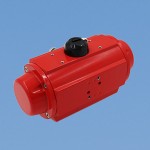
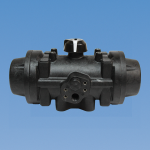
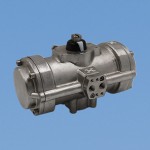
Asahi/America's Series 79 pneumatic actuators for quarter turn ball and butterfly valves provide accurate and dependable control, especially in corrosive applications.

The units are compact, yet extremely durable and available in output torques from 60 to 17,000 inch-pounds based on an 80-psi air supply. Three standard actuator materials are offered: glass reinforced polyamide, cataphoresis & rilsan coated cast aluminum alloy, and 316 Stainless Steel; all of which incorporate ISO and NAMUR mounting configurations for simple installation of accessories. These material choices provide excellent protection from adverse environments & corrosive process materials.

Two versions of this actuator are offered: single acting (air to spring or "failsafe") and double acting (air to air). Both versions utilize a double piston, double rack and pinion design.

There are definitive advantages for using the rack and pinion design; the accuracy of translating linear to rotary torque is one. This is especially important in a modulating application. Another advantage is the constant torque output throughout the travel, which simplifies actuator to valve sizing.

Two (2) pieces of information are required for proper selection of a pneumatic actuator:

First is Valve breakaway torque. This is the amount of torque required to “break” the ball, plug or disc away from the seat. It is calculated from the differential pressure, type of media, contact area between sealing members, etc. Once this is determined, it is multiplied by a safety factor to take into account unknowns such as the amount of time a valve has been in the closed position (some sealing members may take a set, making them difficult to separate) and corrosion buildup.

Second is the air supply to which a conservative approach is required. If an actuator is located adjacent to the compressor, it will most likely see the full 80 psi. But if the actuator is located 100 yards away with leaky air fittings, then the actuator may see only a fraction of the 80 psi that the compressor is producing. So if an actuator is sized for a supply of 80 psi, and the actuator
sees 60 psi because of leaky fittings, there will not be enough output torque from the actuator to cycle the valve.

If the required torque of a valve (including the 25% safety factor) equals or exceeds the output torque of the actuator, then the next size actuator should be selected.